Building Houses

The actual corner stone of our church is Christ. The decorative corner stone on our building was engraved with the words “UNLESS THE LORD BUILDS THE HOUSE THEY LABOR IN VAIN WHO BUILD IT” when is was constructed in 1976. We believed it then, and we believe it now.

I doubt the psalmist was talking about the carpenter from Nazareth when he wrote it. He was stressing the fact that unless the Lord is the driving force behind anything built in His name, no matter how magnificent or modest, it will mean nothing to Him. I trust what we build truly honors Him.

The home our crew in Mexico built for a young family was not intended to bring glory to Chatham Christian Church, but to Christ. It was financed by the material wealth God has blessed us with, undergirded with prayer, and built by loving hands He created. I’m confident He was honored by their labor.

Before the end of July, you should see the ground being prepared for another building we trust will honor Him. The funds for the building came from a couple who kept their eye on the prize, and made sure what God had blessed them with in life would continue honoring Him after they received their eternal reward. It’s our prayer that the gymnasium we’re building will begin being used for His glory sometime this fall.

Their faithfulness in life and death is also making it possible for a church in Jamaica to get a new roof. I spent quite a bit of time on the old roof, patching and painting, with several mission teams that went there to work with Theo and Rose. The old roof had been built by volunteers from the states after the original roof blew off in a hurricane. Even if the roof now being built gets blown off some day, it will not have been built in vain.

There is one more house, actually a home, that will be built here this month. On July 12th I’ll have the pleasure of bringing Anna and Luke together to build a home that will honor Him, as I also did last July with Grace and Zack.

God bless, Rick

Why do bad things happen?

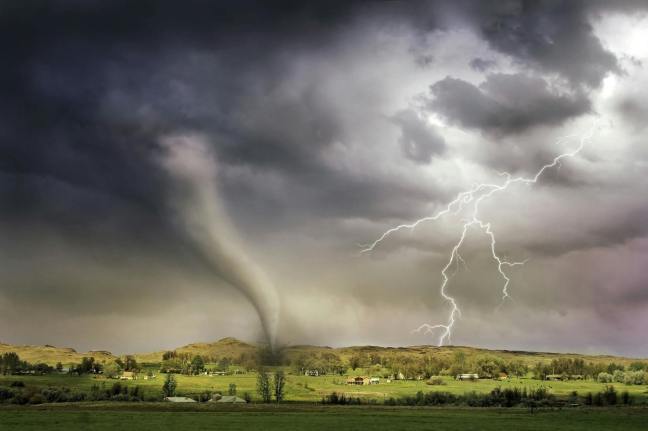
Whether it’s a car crashing through a building, or a tornado knocking one down, we can’t help but wonder why such things happen. Sometimes we can discern a reason, sometimes we can’t.

When bad things do happen, we should first look within to see if God might be disciplining us for something we’re doing. He could be, but He may be simply reminding us how sin has effected the world. If we thought everything was fine the way it is, we’d long for nothing better, and never see the need for a Savior.

When a tragedy is obviously caused by man’s activity, we seldom blame God. But when a tragedy is pegged as an act of God, we struggle to understand why. An article by Hugh Ross, however, gives some understanding to the tragic events that happen in nature.

He noted that scientists are continually learning just how fragile life is in our world. Everything had to be fine-tuned within narrow parameters for life to be possible, and that balance must be carefully maintained. Catastrophic events that are kept under control help do just that. Tornados, hurricanes, earthquakes, volcanoes, wildfires, floods, ice ages, droughts, diseases, parasites, etc. are all set at the optimal frequency and intensity to benefit humanity’s well-being, while minimizing the devastation caused by such things.

After detailing the vital life-dependent benefits that come from such events, Hugh reminds us that the Bible reveals a creator who is all-powerful, all-loving, and all-knowing. And while it might seem as if God is standing idly by while many suffer and die, He sees what’s going on, and has promised to bring good from it.

While we must never minimize the tragedies that befall us, nor fail to show compassion to those who suffer from them, we must not forget that the author of life knows the optimal time for every human life to begin, and to end. And He will always do what’s ultimately best for each person—from His eternal perspective.

God Bless, Rick

Eggs

Eggs have certainly been in the news lately. Prices have flown the coop due to the bird flu and the euthanizing of some fifty million chickens, but the good news for egg connoisseurs is that the free-range brown eggs, with richer yolks, now cost less than the regular supermarket white eggs.

The price increase may have kept some from making it to breakfast tables, but it didn’t keep 30,000 hard-boiled eggs from making it to the White House lawn for the Easter Egg Roll. Those who won the lottery, and were invited to attend, were given the opportunity to decorate 4,500 of the eggs before the roll began, but no religious symbols were allowed. Maybe they should just call it an egg roll.

So how did the egg come to be associated with Easter anyway? In many ancient cultures eggs were seen as symbols of new life, fertility, and the arrival of spring, and the church saw in eggs a picture of the resurrection. The shell could be seen as a tomb, and a chick coming out of an egg could represent Jesus emerging from the tomb.

That may answer how the egg came to be connected with Easter, but there’s an even bigger question about the egg that needs to be answered. Which came first, the chicken or the egg?

This is not a new question, but a philosophical conundrum that Aristotle first wrestled with in the 4th century BC. The Australian Academy of Science, however, claims to have finally solved it.

“It’s that old riddle that’s sparked many arguments through the ages: was it the chicken or the egg that came first? It’s such a tricky question because you need a chicken to lay an egg, but chickens come from eggs, leaving us with an intractable circle of clucky, feathery life that apparently has no clear starting point.”

Their answer is found in the supposed evolution of eggs. But as is coming more clear in scientific circles every day, evolution simply raises more questions than it answers.

The correct answer is that neither came first. God did.

God Bless, Rick

A New Ministry

The following was shared by the elders during our worship service on March 9th.

“When Jack and Bonnie passed away, they left behind a surprisingly large estate of over $2,000,000. At Bonnie’s passing approximately half of it went directly to Ozark Christian College, and around a fourth to Good News Productions. A small amount was to go to the Chatham Library, and the remaining funds and property were bequeathed to us. She did not want it to be used for the general operation of the church, and the elders were tasked with how to best use the funds in keeping with her desires, especially those that focused on her love for young people. After considering several options, the decision was made to use it to begin a totally new ministry at Chatham Christian Church.

Zach, who is currently a campus minister at ISU and very active in the sports ministry of Eastview Christian Church, has made us aware of the effectiveness of using sports as an outreach to youth in the community, and has expressed a willingness to help us lay the groundwork for such a ministry here. We have therefore decided to use the funds to build a gymnasium.

After searching for a local contractor, we found an Amish company in Tuscola, Hersberger Construction, and have signed a contract with them to oversee the building and furnishing of a gym. Our plan is to build a 60 x 120 foot heated and air-conditioned steel building that will be located behind, and attached to, our fellowship hall.

We are planning to begin ground prep for the building after VBS and a large wedding scheduled for the middle of July. Hopefully it will be completed sometime next fall, and we will then be able to use it for basketball, volleyball, pickle ball, and other sporting events, as well as a much larger place for dinners and receptions.”

The elders answered questions during Sunday School, and found nothing but excitement about the new ministry this unexpected gift will make possible.

God Bless, Rick

Phonographs and Pianos

I read an interesting essay last week that began, “When the phonograph was invented, the composer John Phillip Sousa was heartbroken. In a 1906 article on ‘The Menace of Mechanical Music,’ he worried out loud that recording tools would reduce music from a matter of the heart and soul to a mere mechanical process.” The article really caught my attention because I used to love listening to an original recording of Sousa’s band playing Stars and Stripes Forever on my dad’s Edison phonograph
in the attic.

Sousa was worried that recorded music would make us less likely to make music ourselves, and asked, “Why learn to play the piano when you could simply press play?” For Sousa, half of the beauty in music comes from the personal element of its performance. He asked, “When a mother can turn on the phonograph with the same ease that she applies to the electric light will she croon her baby to
slumber with sweet lullabies, or will the infant be put to sleep by machinery?”

The purpose of the essay really wasn’t to discuss Sousa’s concerns about the phonograph, but to call our attention to gains and loses in the use of AI. The author noted that it’s being sold on the premise that it has the ability to chat with you like you a dear friend or give you mental health counseling. He notes, however, that in doing so it robs us of what is most truly intimately human: personal relationships. That friendship, therapy, and family are not merely about mouthing the right sounds or typing the right words.

I think we should indeed be careful about using AI in ways that diminish humanity, but I must admit I’m thankful that Chris used his iPhone to record a few of Bonnie’s songs during the Covid lockdown. Carole had to retire from accompanying due to her health, and Scott was on vacation last week, so Bonnie was back on the piano…sorta.

God Bless,
Rick