Cut to the Heart

One of the best things about reading the Bible in various translations and paraphrases is that you see things you may have missed reading it the same way every time. I was struck by this again last week.

As I was reading the account of Stephen preaching to the Jewish leaders, the way the New King James Version said they responded to his message caught my attention. After noting that Stephen was full of faith and power, had done great wonders and signs among the people, and that the Council had seen his face as the face of an angel, he accused them of resisting the Holy Spirit and persecuting the prophets as had their fathers. He then stated that they had become the betrayers and murderers of the Just One that had been foretold. His rebuke was obviously very harsh, and when they heard these things, they were cut to the heart.

That phrase, “cut to the heart,” sounded familiar to me. I had just read the same phrase a couple of days earlier.

On the Day of Pentecost, after witnessing the miraculous activity of the Holy Spirit, Peter boldly stated that those present had crucified Jesus, the one God had made both Lord and Christ. When they heard it, they too had been cut to the heart. My NASV used different phrases to say the same thing, so I had missed the similarity. What struck me, however, was not the similarity, but the difference in their response.

When Peter’s hearers were cut to the heart they responded by crying, “Brethren, what must we do?”, and 3,000 of them were baptized. When Stephen’s hearers were cut to the heart they gnashed their teeth, and stoned him to death. The difference wasn’t the rebuke. It wasn’t even the emotional response to the rebuke. It was what they did after coming under conviction.

This got me thinking how we are not responsible for the way people respond to the reproofs and rebukes that come from God’s word. Even If we present the truth with grace and the right motive, as I’m sure both Peter and Stephen did, they may or may not receive it positively.

Perhaps even more important, however, is to make certain that we respond to rebukes from God’s word positively.

God Bless, Rick

The Daily Message Challenge

I hadn’t planned on announcing my offer of Bibles for those who would join me in reading it through in 2019 quite yet, but couldn’t help but mention it in my sermon last week on the importance of reading it.

If you recall, last year I offered to personally buy a chronological Bible for anyone who would commit to reading it through in a year. Many of you accepted my challenge, and I was delighted to buy them. Many have kept up, but I’ve heard from some who haven’t managed to stay on track, and even some who have given up. Let me encourage those who didn’t keep up to keep on reading, and not worry about the deal I made with them. The important thing is to just read it.

Anyway, someone asked me several weeks ago what kind of Bible I was planning to read through next year. I had been giving it some thought, but hadn’t yet decided. I really enjoyed reading through chronological Bibles the last two years, but thought I might try something a bit different next year.

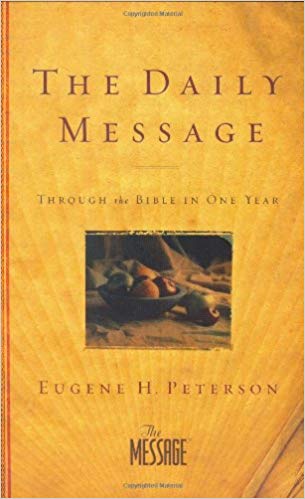
After exploring several options, I decided I would read through The Daily Message by Eugene Peterson. I enjoyed reading through The Message paraphrase several years ago, but this particular plan of reading it through in a year is set up so you alternate reading through Old and New Testament books, so you’re not stuck in the Old Testament for nine months. It also includes a brief reading from Psalms, Proverbs or Isaiah each day.

When contemplating whether to make the offer of buying this more expensive Bible for anyone who would commit to reading it with me, my inclination toward tightness reared its ugly head. So when I mentioned in my sermon that I was planning on making an offer to buy Bibles this year, I hedged a bit, and said I might split the cost with those taking the deal.

After the sermon I was approached by someone who offered to cover the entire cost of the Bibles. When I hesitated to accept his offer, he added an intriguing twist. If anyone doesn’t read it through in a year, they have to pay back the cost of the Bible. I liked the added motivation, so agreed to let him do it.

If you want me to order one for you, there is a sign-up on the bulletin board. I do need to warn you that the printed addition uses very small print, so you may want to simply order a digital copy from Amazon on your own. But if you want a free printed copy, all you have to do is sign-up, and then make sure to read it through in 2019.

God Bless, Rick

Communion Meditations

We are so blessed by those who bring our communion meditation each week. In fact, I’m almost too blessed. They are obviously all worthy of printing in the newsletter, but I can’t print them all.

Three weeks ago Kirk pulled at our heart strings as he shared how his grandfather had responded to strangers in need. The following Sunday Chris shared with us a thought provoking question he had faced at his sister-in-law’s wedding the day before. Last Sunday Jack made us think about our faith on a scale of 1 to 2.

After printing Kirk’s I asked Chris and Jack to give me copies of theirs, and then I had to decide how to squeeze them in. I ended up condensing Jack’s for the front, and am now sharing excerpts from Chris’s for my article. As I said, we are so blessed.

“At about 4 o’clock yesterday afternoon, I found myself in an awkward, but not entirely uncommon situation—talking with a stranger outside of a restroom—having what could have been the most important conversation of this particular man’s life. This man looked at me and asked, ‘Well…is it worth it?’

Perhaps it was after seeing me participate in the tag-team event that is wrangling two children during the hours of running around, waiting around, standing around, and sitting around that is the joy of participating in someone else’s special day. Perhaps it was this that led to an existential crisis about raising a family in today’s world…and to seek wisdom from me, a total stranger.

Or perhaps it was after seeing me saddled with my wife’s and my mother-in-law’s bags, waiting outside of a restroom, that led this man to consider the people in his life that he loves and what sacrifices he could make in order to serve them and others…to seek wisdom from me, a total stranger.

Or perhaps, through some Spirit-given insight, this man, who may have not been a Christian, was seeking guidance from a man who was a Christian on whether or not a relationship with Christ was worth it…and this led him to seek wisdom from me, a total stranger.”

Chris responded with “Yes…yes it is”, and then assured us that that’s how Christ would respond if asked the same question about us.

Copies of both meditations in their entirety are in the hall rack.

God Bless, Rick

Unbelievable?

The unnamed assailant struck again, only this time he suggested that I read a book. But no, he wasn’t handing me something to counteract an error I had made or a position that needed to be confronted. He simply said I’d probably like the book he was offering. I told him I’d add it to the stack on my sofa, but couldn’t promise when I’d get to it. But, for some reason, perhaps because I value his opinions, the book found it’s way to the top of the stack.

The book is Unbelievable? by Justin Brierley. It’s subtitled “Why, after ten years of talking with atheists, I’m still a Christian.” The author is the host of a radio program of the same name in the United Kingdom.

The format of the program is simple; he invites an unbeliever and a believer to interact on the air. Sometimes the opposing views come from Christians, but most often they are between an atheist and a Christian. The show began in 2005 and included a call-in opportunity for listeners, but eventually became a recorded podcast that now has almost 2.5 million downloads a year.

Justin tries to keep his positions out of the broadcast conversations, but decided to put his convictions in print. The book is therefore an apologetic for the faith. And no, apologetics is not making apologies for the faith. The word comes from the Greek word for making a defense. It’s fulfilling the admonition found in I Peter 3:15 to always be ready to make a defense for our faith and to give an account for the hope that is in us.

In some ways this book reminds me of Letters from a Skeptic that we studied together several years ago. That book related the conversations between a believing son and a skeptical father. This one relates some very interesting interchanges that took place on the air.

I found the book to be enlightening, and a joy to read. I’ve included a couple of excerpts from the book inside today’s newsletter. I also have two unmarked copies in the office that you can borrow. Or, I’m sure you can borrow Jonathan’s highlighted copy.  Oops!

God Bless, Rick

Delightfully Corrected

Printing out my sermon so you can read it while I preach it is a two-edged sword that cuts both ways. I really try to follow the preacher of Ecclesiastes’ pattern of seeking to find delightful words and to write words of truth correctly. When I do it successfully everyone has a copy of the words they can reference for further reflection. When it doesn’t go exactly as planned, everyone has a copy of the words, that while being delightful to some, haven’t been written correctly. Such was the case last Sunday morning.

While passing by the “young adult” class I was gleefully accosted by an unnamed assailant. He asked if I really meant what I said in my sermon about those in our society who reject what is obviously contrary to reason and nature. What he said didn’t make sense to me. It was the opposite of what I had said. At least it was the opposite of what I had intended to say.

Other members of the attack squad quickly directed to me the center of my sermon where they had apparently already located the words in question. I had said that our Sunday night study is giving us an understanding of how we’ve come to the place in our society where things that are obviously contrary to reason—and nature itself—are rejected by so many.

Reading it over I discovered the obvious error. The point I was trying to make was that our society has accepted as true things that are contrary to reason and nature. A case in point is how we’re being told that a person’s sexual identity has nothing to do with the way he or she has been created. That our physical characteristics are irrelevant, and that all that really matters is the way we feel.

I had brought up what we are studying on Sunday nights because in our text for Sunday morning Paul admonished us to be kind to all, and show gentleness when correcting others. If we didn’t know each other so well I could have been offended, and would have thought they had missed that point of the sermon.

Truth of the matter is that I loved it!

God Bless, Rick